Custom AI recruitment software: the complete guide for companies that have outgrown their ATS
Outgrown your ATS? A practical guide to custom AI recruitment software: build vs buy, 5-year costs, timelines, India needs, bias and data ownership.
Custom AI recruitment software is a hiring system built around one company's actual workflow, with AI doing the parsing, matching, screening and scheduling that recruiters otherwise do by hand, and with the company owning the code and the candidate data. It suits organisations whose hiring is large, unusual or expensive enough that a subscription ATS has started to shape the process instead of serving it.
This guide is for HR heads, talent acquisition leaders, founders and COOs at Indian mid-size and enterprise companies, and for staffing agencies, who have run Zoho Recruit, Keka, Darwinbox or a similar product and are now weighing a custom build against another year of per-seat fees. It covers what AI does in hiring, where automation ends and AI begins, the build vs buy decision, the cost picture over five years, the shape of a build, the India-specific requirements most global products skip, and the cases where you should keep your subscription. Product names and regulatory dates in this guide are accurate as of September 2026.
What is custom AI recruitment software?
Custom AI recruitment software is an applicant tracking and hiring system designed and built for a single organisation, rather than licensed from a vendor. It uses machine learning and language models to read CVs, match candidates to roles, score and shortlist applicants, run first-round conversations and schedule interviews, all inside a workflow the company defines. The company owns the software, the data and the integrations.
The word "custom" carries the weight in that definition. A subscription ATS gives every customer the same stages, the same fields and the same reports, with settings to adjust within limits the vendor chose. A custom build starts from your hiring process, the way it actually runs on a Tuesday afternoon with forty open roles, and writes the software to match. The AI layer sits on top of that workflow, so a screening model scores candidates on the criteria your hiring managers actually use rather than on a generic fit score.
Custom builds have been possible for years. What changed is the cost of the AI component. Language model APIs now handle CV parsing, semantic matching and candidate conversation at a fraction of what training a dedicated model once cost, which moved custom AI hiring systems from enterprise-only territory into reach for a company with a few hundred employees and a serious hiring load. It is the same build-versus-buy question we walk through in AI in digital marketing, applied to the hiring desk. A firm that already builds custom portals and dashboards with an AI layer and ships SaaS products can apply the same approach to recruitment, which is how our own custom AI hiring software came about.
How is AI actually used in recruitment?
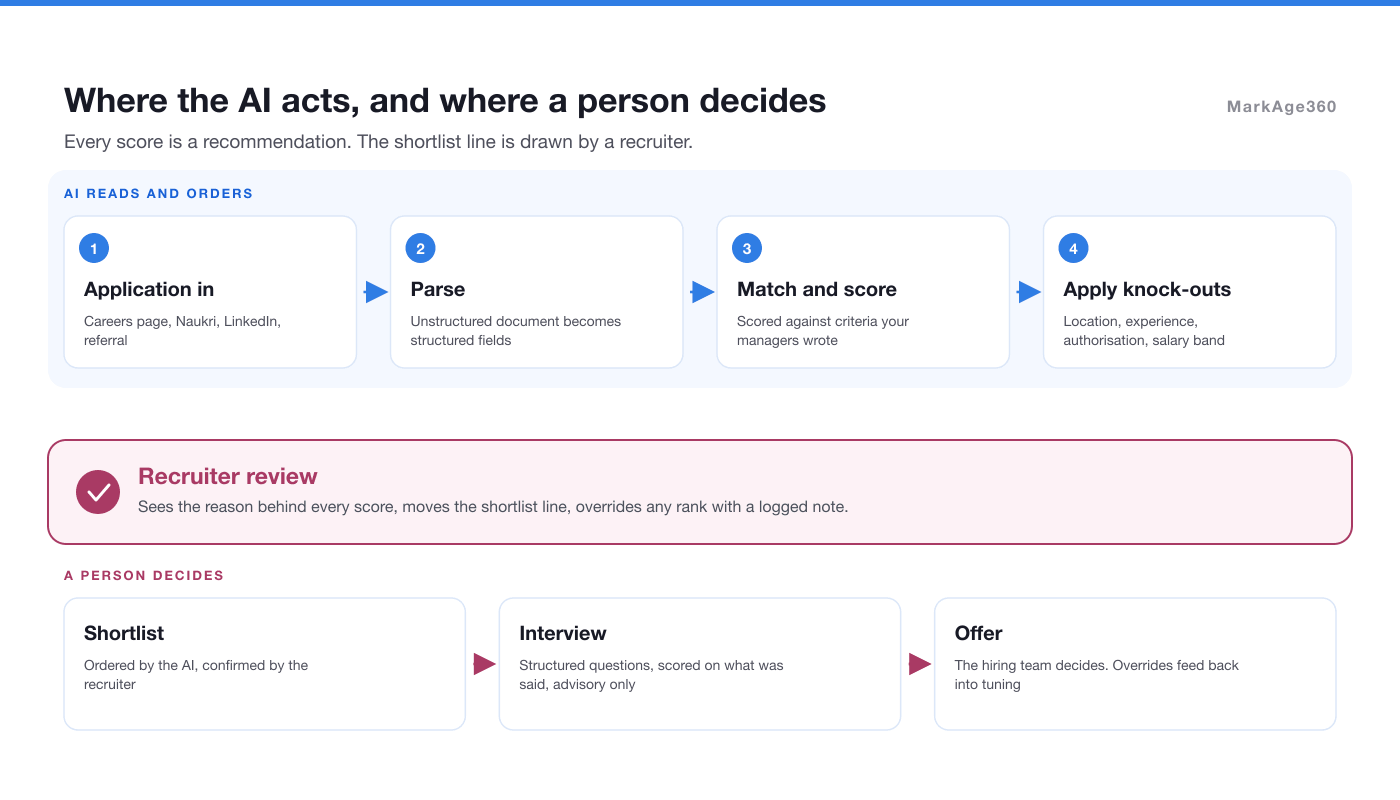
AI in recruitment does six jobs: it parses CVs into structured data, matches and scores candidates against a role, screens applicants against knock-out criteria, conducts or supports first-round interviews, answers candidate questions through chatbots, and reports on the pipeline. Each job is a separate component, and a custom system can include some of them without the others.
The case for it is volume. The average corporate job opening draws around 250 resumes, of which four to six reach an interview (Glassdoor), and an eye-tracking study by Ladders put a recruiter's initial read of a resume at 7.4 seconds. Software gives application two hundred the same attention as application one.
CV parsing
CV parsing turns an unstructured document, whether a PDF, a Word file or a Naukri profile export, into fields a database can hold: name, contact details, employers, dates, titles, skills, education, location and notice period. Older parsers relied on templates and broke whenever a candidate used an unusual layout. Language-model-based parsers read the document the way a person would and cope with the two-column designs, the photo headers and the regional-language education entries that Indian CVs contain in volume.
Matching and scoring
Matching compares the parsed candidate against the role and produces a score. A basic matcher counts keyword overlap. A semantic matcher understands that "accounts receivable executive" and "AR specialist" describe the same work, and that five years at a Big Four firm means something different from five years at a two-person practice. In a custom system, the scoring weights come from your hiring managers: if a manufacturing plant cares more about shift flexibility than about degree, the score reflects that.
Screening
Screening applies knock-out rules and ranks who is left. Knock-outs are the non-negotiables: work authorisation, minimum experience, location, salary band, certification. Ranking then orders the survivors by score. The AI does the ordering; the recruiter decides where the shortlist line falls and can move any candidate across it.
AI interviews
AI interviewing covers a spectrum. At the light end, the system asks structured screening questions by chat or voice and records the answers for a recruiter to read. At the heavier end, it scores responses against a rubric. The light end is mature and useful for high-volume hiring. The heavier end works when scoring is confined to what the candidate said, judged on named dimensions, and kept advisory. It deserves caution when a model grades how someone sounds or looks, and the bias section below explains why.
Candidate chatbots
A candidate chatbot answers the questions that fill a recruiter's inbox: application status, interview timing, documents required, location of the office, what the role pays. On WhatsApp, where most Indian candidates actually reply, a well-built bot also collects missing information and confirms interview slots, the same mechanics as AI appointment booking. The same conversational AI and AI lead qualification work that qualifies sales leads applies almost unchanged to qualifying applicants.
Analytics
Analytics reads the whole pipeline and reports where candidates stall, which sources produce hires, how long each stage takes and where offers are declined. In a subscription ATS you get the reports the vendor ships. In a custom system you get the reports your board asks for, in the units your finance team uses, built the same way as any BI dashboard.
AI recruitment vs recruitment automation: what is the difference?
Recruitment automation executes fixed rules: when a candidate applies, send an acknowledgement; when a stage changes, notify the hiring manager. AI recruitment makes judgements that rules cannot express: which of four hundred CVs best fits a role, or what a candidate meant by a free-text answer. Most useful hiring systems contain both, and confusing the two leads companies to pay AI prices for automation features.
| Dimension | Recruitment automation | AI recruitment |
|---|---|---|
| What it does | Executes predefined rules and triggers | Makes probabilistic judgements from data |
| Example | Auto-email on application; move stage after interview | Rank 400 CVs by fit; summarise an interview transcript |
| Handles ambiguity | No | Yes, within limits |
| Needs training data or a model | No | Yes |
| Explainability | Fully transparent | Requires deliberate design |
| Where it belongs | Every stage, every company | Screening, matching, candidate conversation |
| Typical failure | Rule fires in the wrong case | Model scores on a spurious signal |
The practical test: if you can write the logic as an "if this, then that" sentence, it is automation and it should be cheap, the territory of ordinary workflow automation. If the logic requires reading and weighing, it is AI and it needs oversight.
Build vs buy an ATS: off-the-shelf or custom, which fits your hiring?
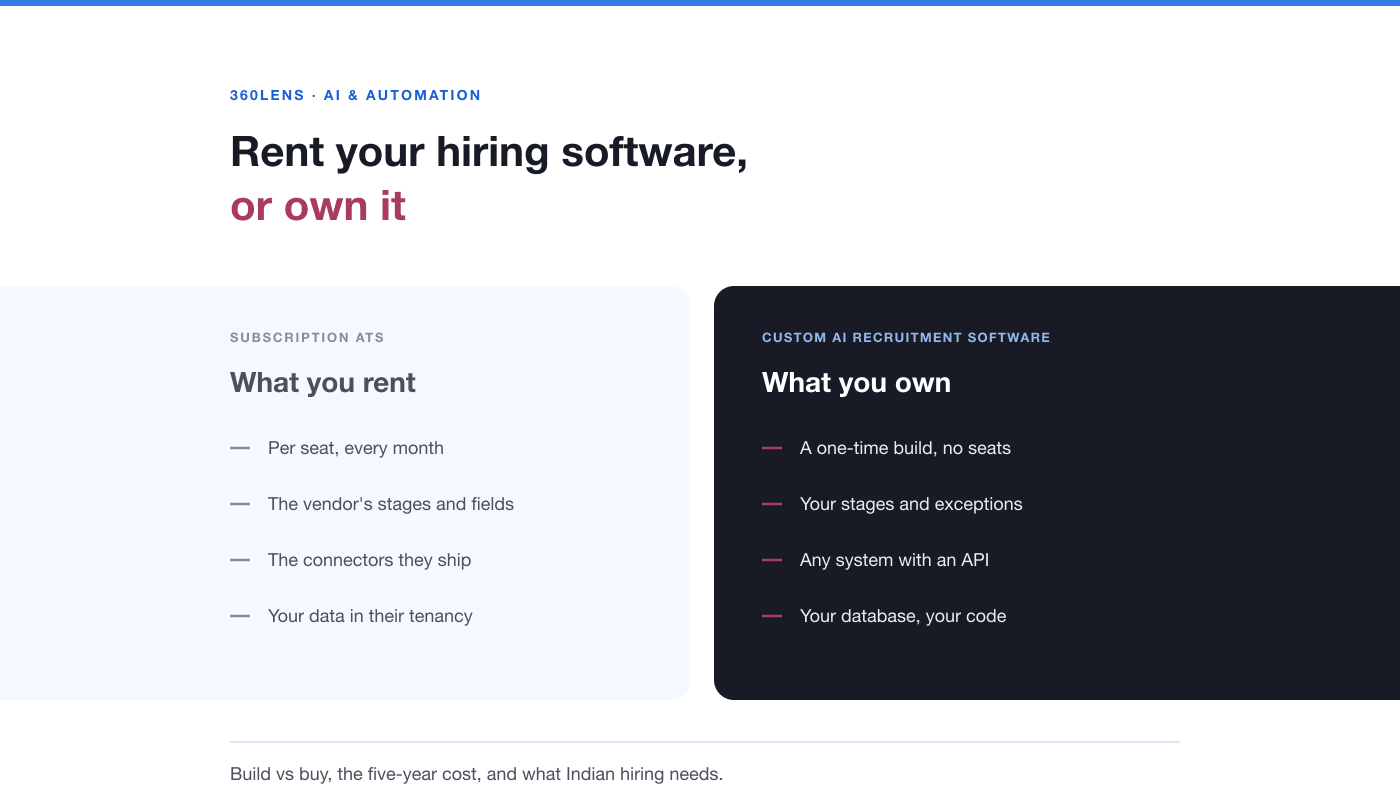
An off-the-shelf ATS such as Zoho Recruit, Keka Hire or Darwinbox is faster to deploy and cheaper for small, standard hiring. A custom build wins when hiring volume is high, the workflow is unusual, integrations are specific to your stack, or the per-seat bill has grown past the cost of owning the software. The comparison below sets out where each option holds the advantage.
| Factor | Off-the-shelf ATS | Custom AI recruitment software |
|---|---|---|
| Cost model | Recurring per-seat or per-module subscription, priced annually with increases at renewal | One-time build cost plus hosting and maintenance you control |
| Workflow fit | Configurable within the vendor's stage and field model | Built to your stages, fields, approvals and exceptions |
| Integrations | Pre-built connectors for popular tools; anything else is a workaround or a paid add-on | Any system with an API, including your HRMS, payroll and job boards |
| Data ownership | Your data sits in the vendor's tenancy under their terms; export is possible but often partial | You own the database, the code and the model configuration |
| Time to deploy | Days to weeks | Months, scoped by workflow complexity |
| Scalability | Adding recruiters adds seats; high-volume plans cost more | Adding users costs nothing beyond infrastructure |
| Maintenance | Vendor handles updates; you inherit every change, wanted or not | You or your build partner maintain it; nothing changes without your decision |
Neither column is right for every company. The subscription products are good at what they are built for: a standard pipeline, live in days, with the vendor carrying the maintenance. The decision turns on volume, workflow and stack, and the next two sections give you a way to test all three.
Seven signs your company has outgrown its subscription ATS
A company has outgrown its subscription ATS when the software dictates the process, the per-seat bill rises faster than the hiring team, and recruiters keep essential work in spreadsheets, WhatsApp and email because the product cannot hold it. The seven signs below are the ones that come up most often in the first conversation with a company considering a build.
- You pay for seats that log in twice a month. Hiring managers, interviewers and approvers each need access, each costs a seat, and each uses the system for a few minutes a week.
- Your process has a stage the ATS cannot model. A background check that runs in parallel with an offer, a two-manager approval, a bench pool for staffing clients. You have a workaround, and the workaround is a spreadsheet.
- Candidates reply on WhatsApp and the ATS does not know. The conversation that decides whether someone turns up for the interview happens outside the system of record.
- Reports go to Excel before they go to leadership. If your monthly hiring review starts with a data export and a pivot table, the software's analytics have already failed you.
- Integration with your HRMS is manual. A hire in the ATS becomes an employee in Darwinbox or Keka through a re-keyed form, the kind of gap CRM and workflow automation exists to close.
- You cannot get your own data out cleanly. Test it: request a full export of candidates, notes, stage history and attachments. If the answer is partial, your data is on loan.
- The renewal quote went up and the roadmap did not. Price rises at renewal are the vendor's decision. The features you asked for two years ago are still on the roadmap.
If four or more of these describe your hiring desk, the sections that follow will tell you what the alternative involves.
Recognise four or more? Book a strategy call. Thirty minutes on your hiring workflow, your current ATS bill and whether a build makes sense. If it does not, we will say so.
What does recruitment software really cost over five years?
Over five years, a subscription ATS costs the number of seats multiplied by the per-seat price, multiplied by sixty months, plus module add-ons, plus the annual price rises written into most contracts, plus the recruiter time spent on workarounds. A custom build costs a one-time design and development fee, then hosting, AI model usage and maintenance at rates you set. Which total is lower depends on team size and how long you keep the system.
This section deliberately gives no rupee figures. Your seat count, your vendor's quote and your build scope produce the numbers, and a guide that made them up would be doing you a disservice. What it can do is name every line so nothing is missed when you build the comparison.
Cost drivers of a subscription ATS
- Seats. Every recruiter, hiring manager, interviewer and approver who needs to log in. Count the occasional users honestly, because they are the ones that inflate the bill.
- Modules. AI screening, video interviewing, assessments, career site, onboarding and advanced analytics are frequently priced separately from the core ATS.
- Tier. Higher candidate volumes and larger databases push you into a higher plan.
- Renewal increases. Read the contract for the escalation clause, and assume it will be applied.
- Workaround labour. Recruiter hours spent re-keying, exporting and chasing on WhatsApp are a real cost that never appears on the invoice.
- Switching cost at exit. Data export, cleaning and migration when you eventually leave.
Cost drivers of a custom build
- Scope. The number of modules you build. Parsing, matching and pipeline management cost less than adding AI interviews and a full candidate portal.
- Integrations. Each external system, whether Naukri, LinkedIn, the WhatsApp Business API or your HRMS, is its own piece of work.
- Data migration. The volume and messiness of the candidate history you bring across.
- AI model usage. Language model API calls are metered. High-volume parsing and chat drive this line; a few hundred CVs a month barely register.
- Hosting. Cloud infrastructure sized to your load, which you can scale down in quiet months.
- Maintenance and enhancement. Someone has to patch, monitor and extend the system. Budget for it as a retainer or an in-house allocation.
A way to run the comparison
Take your current annual ATS invoice and multiply by five. Add the renewal escalation for years two to five. Add a conservative estimate of recruiter hours per week spent on workarounds, priced at loaded cost, times 250 weeks. That is the subscription side. On the custom side, take the build quote, add five years of hosting and model usage at the volumes you actually run, and add five years of maintenance. Compare the totals, and then ask which system you would rather own in year six.
What does custom ATS development actually involve?
Custom ATS development moves through seven phases: discovery, workflow mapping, build, integration, data migration, training and support. For a mid-size Indian company with standard integrations, the work from first workshop to go-live commonly runs between three and six months, with the build and integration phases taking most of that time. The ranges below describe how a project of this kind typically divides; they are planning guides, not a quote, and your scope sets the actual figure. A scoped, per-role deployment is a different scale of project: Hiring Command typically takes a single role live in two to four weeks on a careers page we build.
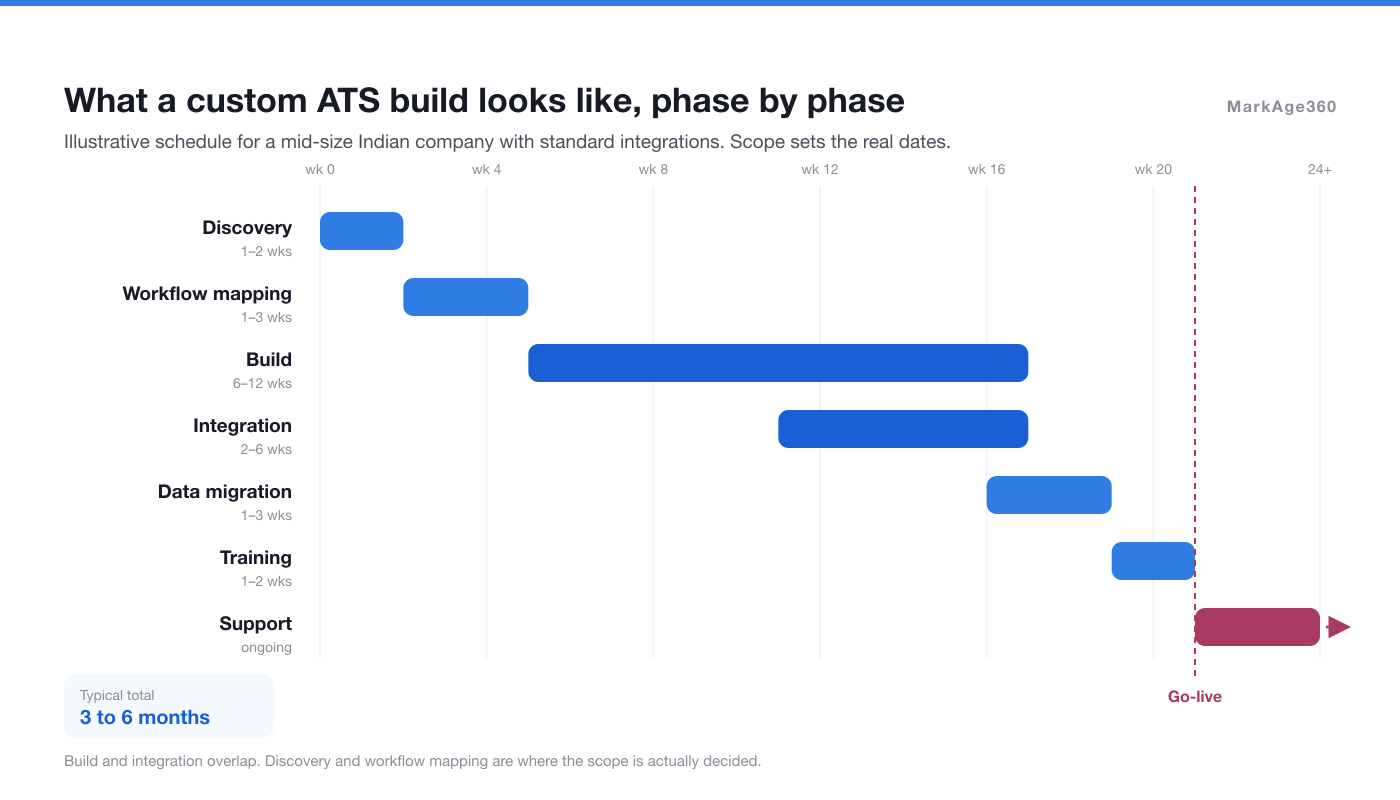
- Discovery (one to two weeks). Interviews with recruiters, hiring managers, HR operations and IT. The output is a written statement of what the system must do, what it must connect to and what it must never do. This is where per-seat frustration gets translated into requirements.
- Workflow mapping (one to three weeks). Every hiring flow is drawn end to end: campus, lateral, high-volume frontline, leadership, contract. Each stage, approval, notification and exception is documented. Most companies discover here that they run more distinct processes than they thought.
- Build (six to twelve weeks). Database, pipeline logic, user roles, AI parsing and matching, recruiter interface, candidate-facing pages. Work happens in short cycles with recruiters reviewing working screens, so the first thing they see is their own process on a screen rather than a specification. This is standard web application development practice applied to hiring.
- Integration (two to six weeks, often overlapping the build). Job boards, LinkedIn, the WhatsApp Business API, calendar systems, your HRMS, email and single sign-on. Each connector is tested against live data with a small user group. See our API and back-end integration work for how this is handled.
- Data migration (one to three weeks). Candidates, notes, stage history, attachments and consent records exported from the old system, cleaned, mapped to the new structure and loaded. Parallel running for a defined period catches what the mapping missed.
- Training (one to two weeks). Role-based sessions for recruiters, hiring managers and administrators, with written guides. The system is only as good as the habits people form in the first month.
- Support (ongoing). Monitoring, fixes, model tuning as your hiring criteria evolve, and enhancements as new needs appear. Agree the terms of this before the build starts, because a system nobody maintains decays.
The discovery and mapping phases are where a custom project earns its cost. A vendor cannot do them for you because a vendor sells the same product to everyone. A build partner does them because there is nothing to build until they are done.
What does an Indian company need that a global ATS rarely gives it?
Indian companies need recruitment software that integrates with Naukri and LinkedIn as sourcing channels, runs candidate communication over WhatsApp, handles high-volume hiring without per-candidate pricing, and stores candidate data in line with the Digital Personal Data Protection Act, 2023 and the DPDP Rules, 2025. Global ATS products built for US and European hiring treat most of these as edge cases. In India they are the main case.
Naukri and LinkedIn integration
Naukri remains a primary source of applicant volume for many Indian mid-market roles, and LinkedIn carries much of senior and specialist hiring. A custom system pulls applications from both into a single pipeline, deduplicates candidates who applied through more than one channel, parses profiles into structured records and tracks source-to-hire so you know which channel your recruiter budget should follow. Where a job board offers an API, the integration is direct; where it does not, structured email intake and scheduled imports do the job.
WhatsApp as the primary candidate channel
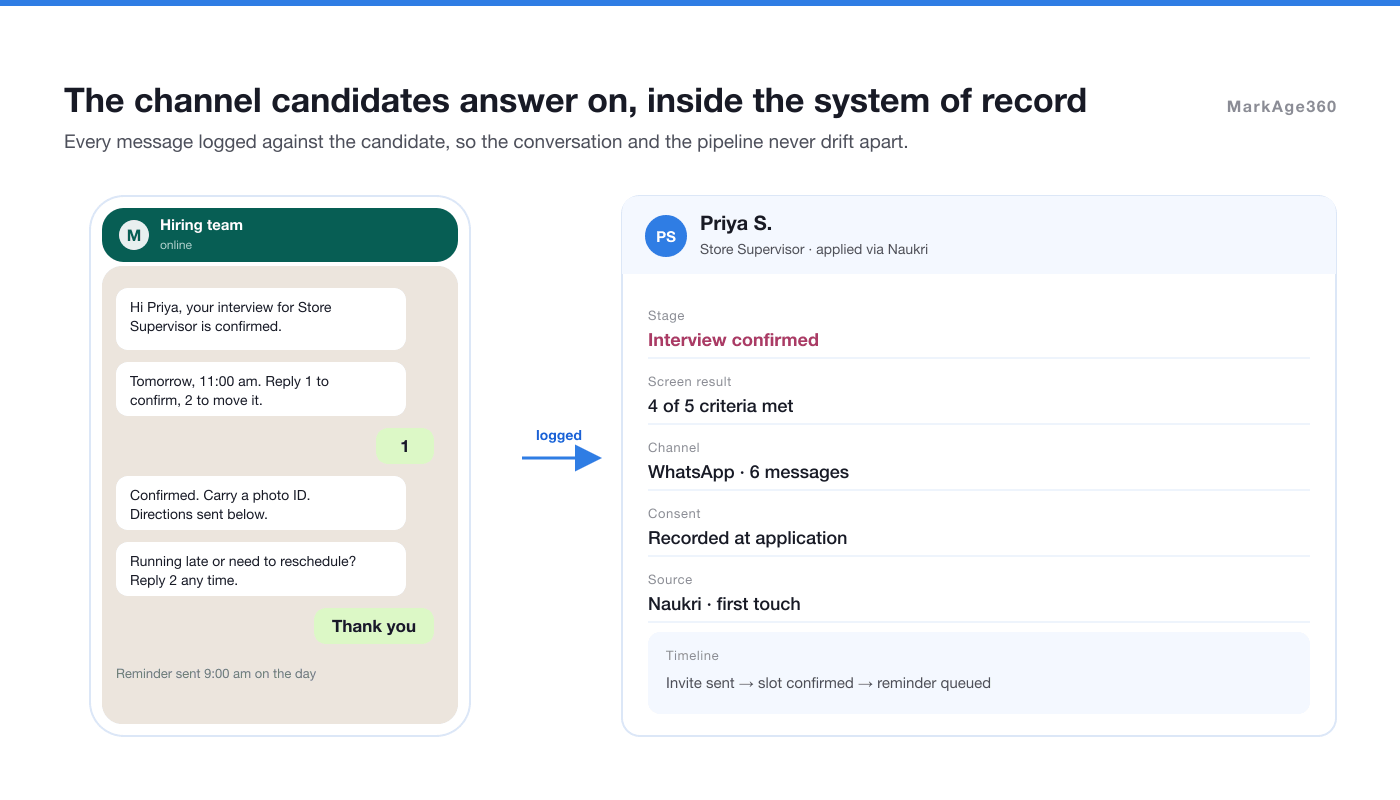
Most Indian candidates respond on WhatsApp long before they open an email. A custom system built on the WhatsApp Business API sends interview invitations, collects documents, confirms attendance the morning of the interview and answers status questions, with every message logged against the candidate record. For high-volume roles this is often the change that does most to reduce no-shows, and it is one that subscription ATS products frequently handle through a bolt-on charged separately. Our WhatsApp and messaging automation page describes the same infrastructure applied to customer conversations.
High-volume hiring
Retail, logistics, BPO, manufacturing and quick commerce hire in hundreds or thousands per month, often for the same handful of roles. A system built for this treats screening as a funnel: knock-out questions on WhatsApp, automatic scheduling into walk-in slots, bulk offer generation and attrition tracking at thirty and ninety days. Per-candidate or per-seat pricing punishes exactly this pattern, which is why high-volume employers have the strongest case for a custom build.
The DPDP Act and candidate data
The Digital Personal Data Protection Act, 2023 governs how Indian companies collect, store and use personal data, and candidate data falls squarely within it. The government notified the Digital Personal Data Protection Rules, 2025 in November 2025 with phased commencement: the main obligations on companies that hold personal data are scheduled to apply from May 2027. Confirm current dates against the official notification before you plan, because the timeline can be amended.
In practice a recruitment system needs to record consent at the point of application, state the purpose for which data is held, allow a candidate to request access, correction or erasure, hold data no longer than the stated purpose requires, and report breaches as the Act and its Rules require. A custom build lets you encode these obligations as system behaviour, with retention schedules and consent logs built into the data model, rather than relying on a vendor whose data residency and processing terms were written for another jurisdiction. This is general guidance, not legal advice; have counsel review your obligations.
How do you keep AI screening fair, secure and under human control?
AI screening stays fair, secure and under control when the model scores only on job-relevant criteria, recruiters can see why a score was given and override it, candidate data is encrypted and never used to train a vendor's models, and the system's outputs are audited for disparities on a schedule. Each of those is a design decision made during the build, and each is easier to get right in software you own.
Bias reduction
Bias in AI screening comes from two sources: the data the model learned from, and the signals it is allowed to see. A well-designed system addresses both. It should mask name, gender markers, age, photo and address from the scoring step so the model cannot learn a proxy for a protected characteristic. It should score against explicit, written criteria agreed with hiring managers, so "fit" is never an unexplained number. It should produce a short explanation for every score, naming the criteria that drove it. And it should run periodic checks comparing shortlist rates across groups so a drift shows up in a report before it shows up in a complaint. Put each of these in the specification; none of them happens by default.
AI interview scoring deserves the most scrutiny. Accent, connection quality and speaking style can influence a model in ways that have nothing to do with the job. The safer pattern is to score the content of each answer against named dimensions, such as relevance, specificity and credibility, keep the result advisory, and have a person watch the interview and make the decision. Integrity signals, such as a switched tab or a second face in frame, should be treated as weak signals and never stated as proof.
Human override
Recruiters override the AI in a well-built system, and the override is recorded. Every AI score is a recommendation. A recruiter can move a candidate up or down the shortlist, exclude someone the model ranked highly, or advance someone it ranked low, with a note explaining why. Those notes are valuable: over time they show where the scoring model disagrees with experienced recruiters, and that is where the model gets tuned.
Data security and model training
Candidate data in a custom system should be encrypted in transit and at rest, with role-based, logged access and a database that sits in infrastructure you control. When the system calls a language model API for parsing or matching, it should do so under terms that exclude your data from the provider's training set, and send only the fields the task needs. Your candidate pool should not become someone else's training corpus. Ask any vendor, subscription or custom, to put that in writing before you sign, and read our own terms and privacy policy for how we treat client data.
When should you not build custom recruitment software?
You should not build custom recruitment software if your hiring team is small, your process follows the standard stages a subscription ATS already models, your integrations are covered by existing connectors, or you need a working system this month. In those cases a subscription product is cheaper, faster and good enough, and a build would be an expensive way to arrive at something similar.
Be honest with yourself about four situations:
- Small teams. Fewer than a handful of recruiters and a few dozen hires a year rarely accumulate enough per-seat cost or workflow friction to justify a build.
- Standard workflows. If your process is source, screen, interview, offer, with one approver and no parallel steps, most ATS products model it out of the box.
- Urgent timelines. A custom build takes months. If you need a system live this week because a hiring drive starts on Monday, buy a subscription now and revisit the build once the drive is over.
- No appetite for ownership. Owning software means someone maintains it. If you have no internal or partner capacity for that, and no wish to acquire it, a vendor's managed product is the right choice.
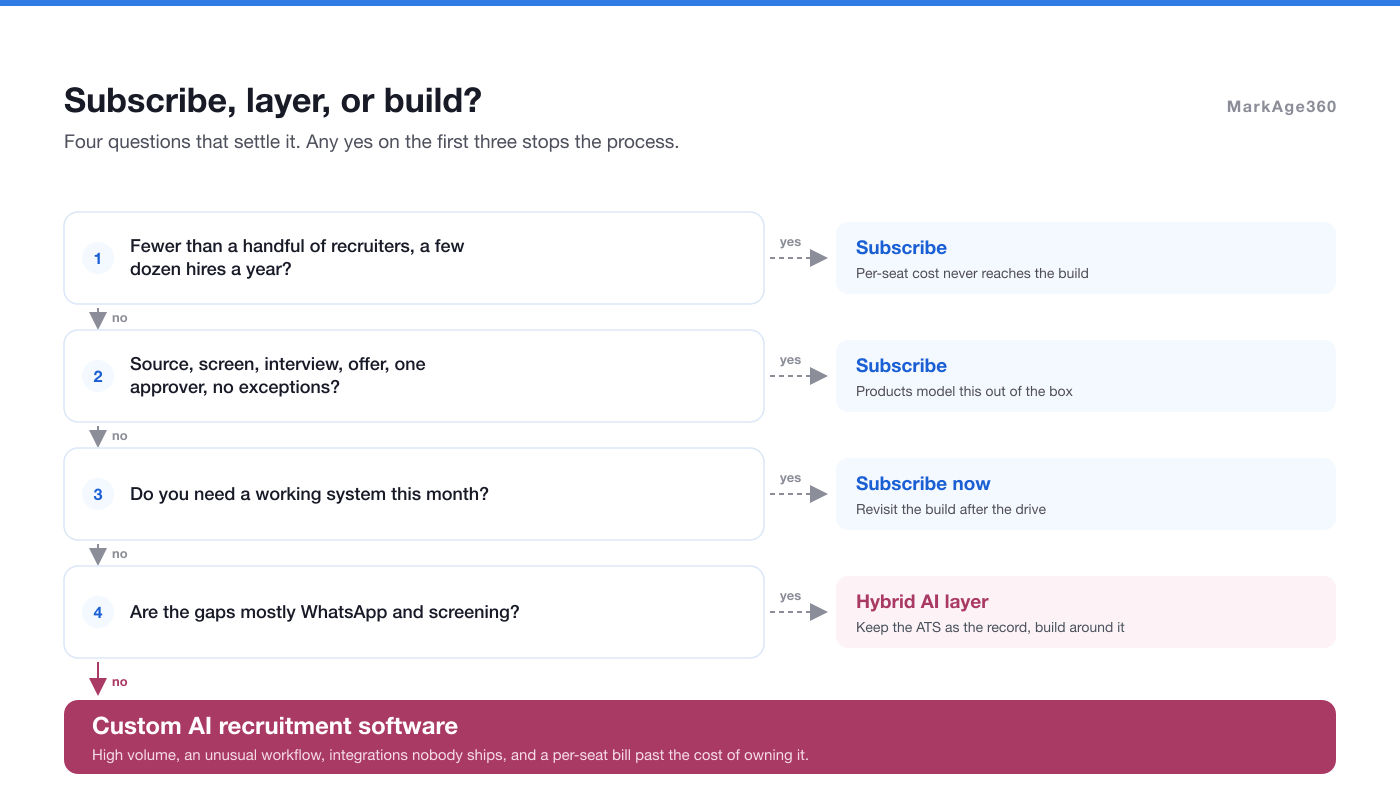
There is also a middle path. Some companies keep a subscription ATS as the core record and build a custom AI layer around it for the parts the vendor does badly, most often WhatsApp communication and screening. That approach limits the build scope and lets you test the model before committing to it fully. The smallest version is a single role: screening and an AI video interview on one careers page, live in weeks, which is how most Hiring Command engagements begin. Our AI and automation and AI integrations work frequently starts this way.
How Hiring Command by MarkAge360 approaches this
Hiring Command is MarkAge360's custom AI hiring software, and the platform we run on our own roles. It is built per role rather than rented by the seat. You write up to five criteria in your own words and set how many a candidate must meet, a threshold rather than a checklist. Every application and CV is read in full against those criteria, and each one comes back met or not met with one sentence of evidence. A criterion with nothing behind it is a miss, and a CV is treated as candidate data, never as instructions to the screener.
Candidates who clear your bar are invited to an AI video interview straight away, on the page they applied from and by email, with a link valid for 48 hours. Before anything records, they are told what the interview is and what happens to the video, tick a consent box and check their camera and microphone. The interview runs in the browser and asks your questions aloud. Each answer is scored one to five on relevance, specificity and credibility, with a written summary and an advisory recommendation. A person on your team watches the interview and makes the call.
It ships with its own careers page, application form and review screen, or is scoped around the ATS you already run. Pricing is a one-time build plus an ongoing fee for model usage and support, with no per-seat licence, and a single role typically goes live in two to four weeks. WhatsApp reminders, calendar booking and candidate chat connect through our WhatsApp automation, appointment booking and conversational AI work. Clutch named MarkAge360 a Top AI Agents Company in 2025.
Our longest-running client proof is in a different field, and we will not dress it up as a hiring result: for GMAC, a 90-day mandate for one region grew into four regions and 400,000+ leads across 20+ countries over seven years (GMAT case study). That is performance marketing, not recruitment software. What it shows is how we work: scope tightly, report in the client's own units, and stay accountable long after launch.
Frequently asked questions
What is custom AI recruitment software?
Custom AI recruitment software is a hiring system built for one organisation rather than licensed from a vendor, using AI to parse CVs, match and score candidates, screen applicants and manage candidate conversations inside a workflow the company defines. The organisation owns the code, the database and the integrations. It differs from a subscription ATS in that the software is shaped to the company's process instead of the company adapting its process to the software.
How is it different from an off-the-shelf ATS like Zoho Recruit or Keka?
Zoho Recruit and Keka Hire are multi-tenant subscription products: every customer uses the same stages, fields and reports, configured within limits the vendor sets, and pays per seat. A custom build starts from your workflow and your integrations, has no seat count, and puts the data and code in your hands. The subscription is faster and cheaper to start; the custom build fits better and costs less to scale once hiring volume and team size grow.
Is it cheaper to build or buy recruitment software?
Buying is cheaper for small teams with standard workflows, because a subscription spreads development cost across thousands of customers. Building becomes cheaper over a five-year horizon when seat counts are high, module add-ons multiply, renewal prices escalate and recruiters spend hours on workarounds. Run the comparison with your own invoice: multiply your annual ATS cost by five, add escalation and workaround labour, and set it against a build quote plus five years of hosting and maintenance.
How long does it take to build and deploy?
A custom recruitment system for a mid-size Indian company with standard integrations commonly takes three to six months from discovery to go-live, with the build and integration phases taking most of that time. Simpler scopes finish faster; systems with AI interviewing, a full candidate portal and many integrations take longer. These are planning ranges for a full ATS replacement, not a quote. A narrower deployment is much faster: MarkAge360's Hiring Command typically takes a single role live in two to four weeks, with integrations to existing systems adding time. Discovery and workflow mapping, which set the scope, typically take the first two to five weeks.
Who owns the software, data and IP?
Ownership is set by the contract, so settle it before the build starts. In a full custom build the client typically owns the software, the data and the intellectual property: the contract should state that source code, database schema, model configuration and documentation are delivered to you and that you may host, modify or hand the system to another team at any time. If the partner instead hosts and runs the system for an ongoing fee, that can be the right arrangement for a smaller team, but know which one you are signing and price it accordingly. Candidate data should be yours in either case.
Are there recurring or per-seat fees?
Custom recruitment software has no per-seat fees, because you own the system and can add as many users as you need. There are recurring costs of a different kind: cloud hosting, metered usage of language model APIs for parsing and chat, and maintenance or enhancement work, whether by an in-house team or a partner on retainer. Those costs are set by your usage and your choices rather than by a vendor's price list, and they do not rise because you hired more recruiters.
Can it integrate with Naukri, LinkedIn, WhatsApp and our HRMS?
Yes. A custom system integrates with any platform that exposes an API or a structured feed, which includes LinkedIn, the WhatsApp Business API and Indian HRMS products such as Darwinbox and Keka. Naukri integration uses the job board's available interfaces or structured email intake where an API is not offered. Each integration is scoped, built and tested as its own piece of work during the build, and adding one later does not require a vendor's roadmap approval.
How does the AI screen and rank candidates, and can recruiters override it?
The AI parses each CV into structured fields, applies knock-out rules such as location, experience and work authorisation, then scores the remaining candidates against written criteria agreed with hiring managers and produces a ranked shortlist with a short explanation for every score. Recruiters can override any score, move any candidate across the shortlist line and record a reason. Overrides are logged, and the pattern of disagreements is used to tune the scoring over time.
How is bias reduced in AI screening?
Bias is reduced by masking name, gender markers, age, photo and address from the scoring step, by scoring only on explicit job-relevant criteria, by producing an explanation for every score so a recruiter can see what drove it, and by running scheduled checks that compare shortlist rates across candidate groups. AI interview scoring is the highest-risk component: it should judge what was said rather than how it sounded, stay advisory, and leave the decision to a person who has watched the interview. Make each of these a written requirement in the build specification.
Is candidate data secure, and is it used to train AI models?
A properly built custom system encrypts candidate data in transit and at rest, keeps access role-based and logged, and holds the database in infrastructure you control. Calls to language model APIs should be made under terms that exclude your data from the provider's training, with only the fields the task needs being sent. Consent, purpose and retention should be recorded in line with the Digital Personal Data Protection Act, 2023 and its Rules. Get all of this in the contract.
Can you migrate our existing ATS data?
Yes, in most cases. Candidates, notes, stage history, attachments and consent records are exported from the current system, cleaned, mapped to the new data structure and loaded, followed by a period of parallel running to catch gaps. How complete the migration is depends on what your current vendor's export actually contains, so request a full test export early. It is the most reliable way to find out how much of your data you really hold.
What support and maintenance come after launch?
After launch a custom system needs monitoring, security patching, fixes, tuning of the scoring model as hiring criteria change, and enhancements as new needs appear. This is handled by an in-house team or by the build partner on a retainer. Agree the scope, response times and handover terms before the build begins. Because you own the code, you can move maintenance in-house or to another partner at any point.
Next step
If your hiring has outgrown a per-seat ATS, the fastest way to find out whether a custom build makes commercial sense is to put your workflow and your current invoice side by side.
Book a strategy call. Thirty minutes, tailored to your hiring process. Or see how Hiring Command reads, scores and interviews first. No obligation, and an honest answer if a subscription is still the right call for you.

Shekhar Malhotra
Chief Content Writer
Shekhar Malhotra writes on AI in marketing, marketing automation, and content strategy at MarkAge360.
Writes aboutAI in marketingMarketing automationContent strategy