SEO for Engineering Companies: 7 Lessons From an 87.5x Growth Case Study

SEO for engineering companies in seven lessons from a real case study: site structure, technical content, keyword research and enquiries by country.
What is SEO for engineering companies?
SEO for engineering companies is the work of making a firm's services, products, applications and project references findable by the people who search before a tender or a specification is written. Those people are specifiers, consultants, plant and project owners, and engineering, procurement and construction (EPC) contractors. It means structuring technical knowledge so that a search engine can read it and a practising engineer trusts it.
The right plan depends on the business. A consultancy needs pages for each discipline, visibility in the places it works and a project portfolio. A manufacturer or exporter depends more on specifications, application pages and visibility in several countries.
We are MarkAge360, a digital marketing firm in Gurugram. We ran the search programme for Encardio Rite, a maker of geotechnical instrumentation and monitoring systems for dams, bridges, tunnels, metros and mines. Shekhar Malhotra, the author of this guide and the founder of MarkAge360, led the growth strategy for that programme.
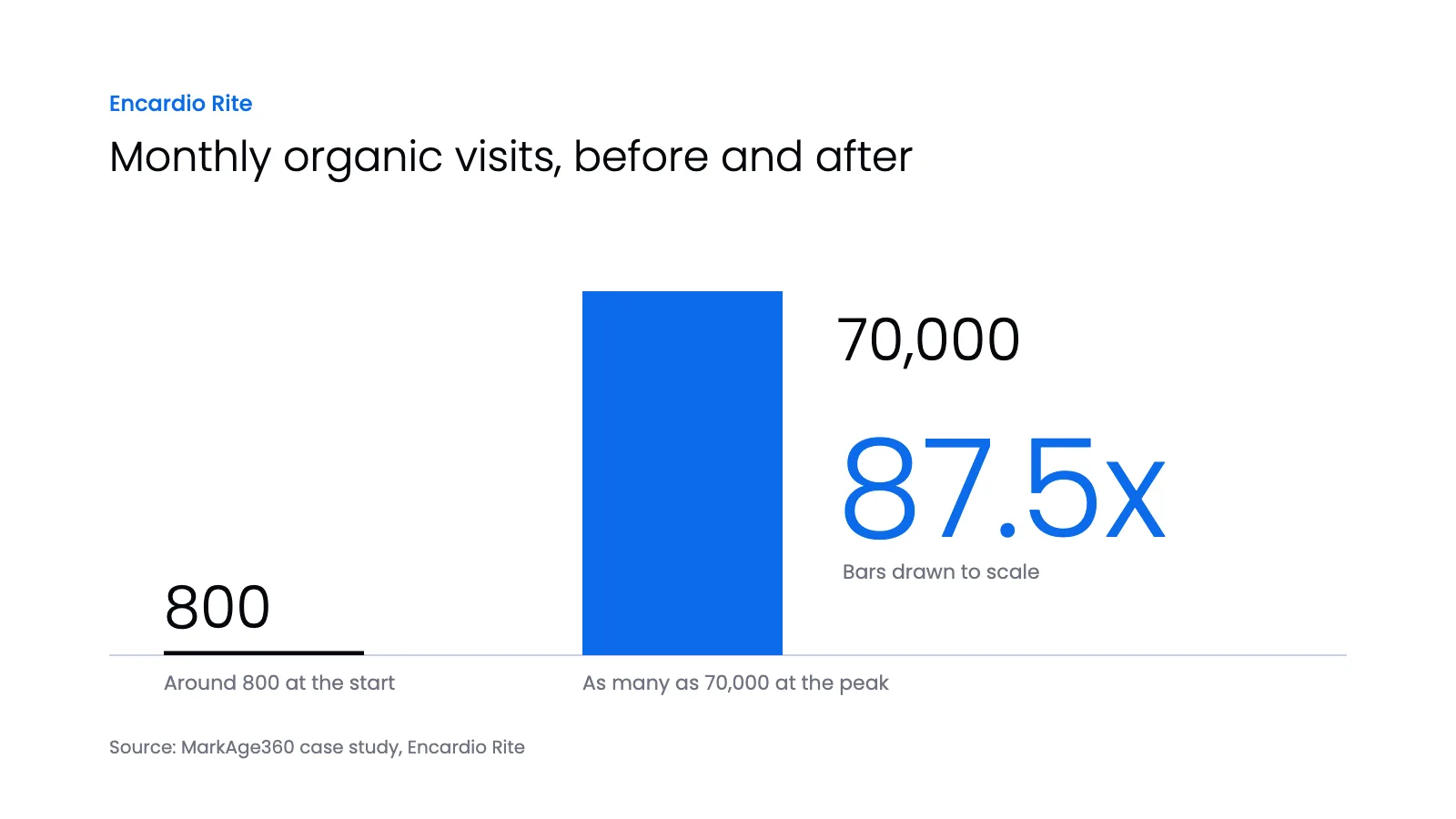
Monthly organic visits went from around 800 to a peak of as many as 70,000, which is 87.5x, according to our published Encardio Rite case study. This guide sets out the seven lessons behind that figure and how other engineering businesses can adapt them. It is written for anyone responsible for marketing for geotechnical and engineering firms, whether the firm sells in one city or across borders.
Why does generic SEO advice fail engineering companies?
Generic SEO advice fails engineering companies because it overlooks how technical buyers search and decide. Much of it is written around local listings and "near me" searches. That advice is still useful to a consultancy that wins work in one region. It does little for a manufacturer that exports instruments, which is found through product parameters, applications and project references, in several countries at once.
Most guidance on SEO for engineering firms misses four things about an exporter:
- The searcher is rarely the buyer. The person searching is the specifier or the consultant's engineer. The purchase order arrives much later, from an EPC contractor working to that specification.
- The product is chosen by parameter. Range, accuracy and output signal decide the shortlist. Adjectives do not.
- Proof means a project reference. A testimonial carries little weight with someone who wants to know where the instrument has been commissioned.
- The market is several countries. Ranking in India says nothing about ranking in the USA or Australia.
A long tender cycle is the reason to do this work. Search does nothing to shorten the cycle. What it changes is where you enter it: at the point where a consultant is deciding which instrument type to write into the specification, instead of at the bill of quantities stage, when the choice is already made.
Most engineering firm marketing is still judged on brochures and exhibition stalls, and engineering SEO gets treated as a website chore. If your competitors treat it the same way, the technical questions in your field are being answered by distributors and forums. The first manufacturer to publish a competent answer has little to displace.
The same reasoning holds for SEO for industrial companies and manufacturers outside geotechnics. The examples below come from one sector because that is where our numbers are.
How does SEO differ across engineering businesses?
SEO differs across engineering businesses because each kind of firm is searched for in a different way. A consultancy is searched by discipline and place. A manufacturer is searched by product and specification. A contractor is searched by capability and past projects. The pages that matter most follow from that.
| Engineering business | How buyers search | Pages that matter most |
|---|---|---|
| Civil or structural consultancy | By discipline and location | Service pages, location pages, project portfolio |
| Instrumentation or equipment manufacturer | By product, parameter and application | Product pages with specifications, application pages |
| Industrial exporter | By application, in several countries | Application and project pages, tracked by country |
| Specialist contractor | By capability and structure type | Capability pages and project pages |
| Mechanical or process engineering firm | By process and industry served | Capability, process and industry pages |
The search phrases in this table describe patterns and are not measured keyword volumes. The seven lessons below come from a manufacturer and exporter. Lessons 4, 5 and 7 apply to every row. Lessons 1 to 3 and Lesson 6 need adapting if you sell services in one region and not products across borders.
How should an engineering company research keywords?
An engineering company should research keywords by starting from the words its own engineers and customers use, and then checking those words against real search data. Internal model codes and brochure language are rarely what a buyer types.
- Collect phrases from enquiries, tender documents and the questions your sales engineers answer most often.
- Sort them by intent. Some are commercial, such as a search for a supplier or a service. Some are informational, such as how an instrument works.
- Check each phrase in Semrush or Google Search Console, country by country, before you build a page for it.
- Give each phrase one page. Two pages chasing the same phrase compete with each other.
- Keep the specific phrases. A precise technical term with few searches often brings a better enquiry than a broad term with many.
Where did Encardio Rite start: known in the industry, hard to find online?
Encardio Rite started as a firm well known inside its industry and hard to find online, with around 800 organic visits a month. In our experience, Indian engineering exporters with decades of project references are often in the same position: the authority is real and a search engine cannot see it.
Here is what changed, as recorded in our case study and in Semrush.
- Monthly organic visits went from around 800 to a peak of as many as 70,000, as published in our Encardio Rite case study. The larger figure is a peak month. It was not a steady level.
- The same case study records 2,539 top-ten positions across five markets, 952 of them in the top three.
- Semrush shows "temperature sensor" at No. 1 (India database, pulled 23 November 2026) and "bridge monitoring sensors" at No. 1 (USA database, pulled 23 November 2026).
- Semrush shows "check dams" at No. 2 and "seismograph" at No. 3 (India database, pulled 23 November 2026).
- Encardio Rite rated the work 5.0 on Clutch.
What we did is simple to describe. We mapped the market by product, by application and by project. We wrote for practising engineers and answered the questions they were already searching. We built the managing director's presence on LinkedIn so the expertise had a face. The seven lessons below break that work into its parts.
Lesson 1: How do you map an engineering market by product, application and project?
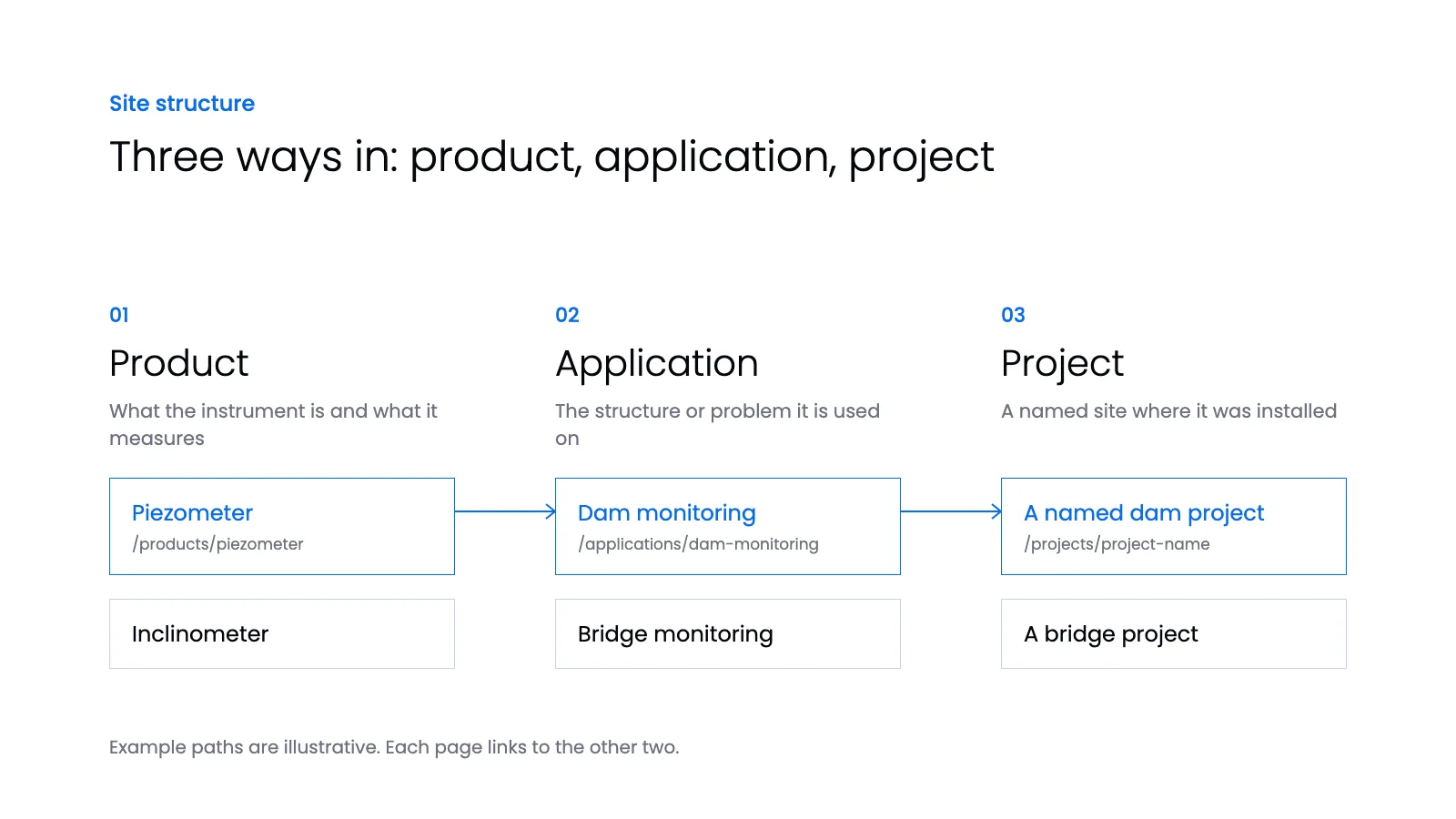
Mapping an engineering market three ways means building one set of pages for what you make, one for where it is used, and one for where it has been installed. Each set answers a different search, and each links to the other two. For Encardio Rite, this map was the foundation of everything else.
| Map | Who searches this way | Encardio Rite examples | What the page must do |
|---|---|---|---|
| Product | The specifier comparing instruments | Piezometers, inclinometers, tiltmeters, strain gauges | Answer the specification question |
| Application | The consultant designing a monitoring scheme | Dam monitoring, bridge monitoring, tunnel monitoring, landslide monitoring | Show which instruments go where, and why |
| Project | The engineer checking your references | Landmark sites, each on its own page | Prove the instrument has been commissioned and has performed |
A catalogue site has only the first column, and usually a thin version of it. That is why it ranks for very little. SEO for geotechnical companies works when all three columns exist and point at each other.
To build the map for your own firm:
- List every product family, using the name an engineer would type and not your internal model code.
- List every structure or problem your products are used on. Each one is an application page.
- List the project references your export sales team quotes most often. Each one is a project page.
- For every product, note the applications it serves and the projects it was used on. Those notes become your internal links.
Lesson 2: What should an engineering product page contain to answer the specification question?
An engineering product page should give a specifier everything needed to decide whether the instrument fits the specification, without opening a PDF or sending an email. That means the measured parameter, the operating principle and the performance data sit on the page itself as readable text. A photograph with a "download datasheet" button does not do this.
For a piezometer page, the specifier is asking questions like these:
- What does it measure, and by what principle, for example vibrating wire?
- What ranges are available, and what are the accuracy and resolution?
- What is the operating temperature range, and is temperature measured at the sensor?
- What is the output signal, and which dataloggers read it?
- How is it installed, and what goes wrong during installation?
- Where has it been used?
Put the performance data in a table. Tables are easy for an engineer to scan, and a search engine or an AI answer tool can lift a table cleanly.
Keep the datasheet PDF as a download, but do not let it be the only place the data lives. Google can index a text-based PDF, so the content is not invisible. A web page is still easier to read on a phone at site, and it can link to your application and project pages in a way a PDF rarely does. Moving datasheet content onto structured pages is a technical SEO job as much as a writing one.
Lesson 3: What is an application page, and why does an engineering company need one?
An application page explains how a structure or a ground problem is monitored and which instruments do the work. An engineering company needs application pages because consultants often search by the problem first, such as dam monitoring or tunnel monitoring, before they search for any instrument by name.
A good dam monitoring page reads like a short design note. It says what needs measuring in the foundation and the dam body, which instrument measures each quantity, and how the readings reach the person responsible for the structure.
Every instrument named on the page links to its product page. Every claim of experience links to a project page.
This is where a manufacturer meets buyers who have never heard of the brand. Semrush shows Encardio Rite at No. 1 for "bridge monitoring sensors" (USA database, pulled 23 November 2026). That is an application search, made by someone looking for a solution before they know any supplier's name.
Application pages also carry informational searches around the structure itself. Semrush shows Encardio Rite at No. 2 for "check dams" (India database, pulled 23 November 2026), a term that describes a structure and no product at all.
Lesson 4: How do you turn landmark projects into searchable proof?
Landmark projects become searchable proof when each one has its own page, written as an engineering account and linked to the products and applications involved. A list of client logos or a line in a PDF brochure does not show up when a consultant searches for a similar project. We turned Encardio Rite's landmark sites into their own searchable pages for this reason.
A project page that works follows this order:
- The structure and the problem. What was being built or protected, and what risk needed monitoring.
- The monitoring scheme. Which instruments were chosen and why, with links to each product page.
- Installation and commissioning. Site conditions, constraints, and how they were handled.
- Data and outcome. How readings were collected and what the monitoring allowed the project team to do.
- The reference details. Location, structure type, and the client's name where the contract permits it.
Where the contract does not permit a name, publish the page without one. The engineering detail carries the page, and a consultant can tell a real project from an invented one.
Your engineers already have this material in commissioning reports. The work is editing it into a form a stranger can follow.

Lesson 5: How do you write for practising engineers?
Writing for practising engineers means answering the question they typed, in the first lines, with the accuracy of a technical note and the readability of a good textbook. For Encardio Rite, we wrote on the questions engineers were already searching: how a piezometer works, types of inclinometers, dam instrumentation and tiltmeter installation.
There are two common mistakes. Content written by engineers alone is accurate and unreadable. Content written by an agency alone reads well and gets laughed at in the design office. The fix is a division of labour:
- An engineer supplies the substance and has the final say on every technical statement.
- A writer decides the structure, the headings and the order of the answer.
- Nothing goes live until the engineer has approved it.
This is what a technical content programme for an engineering firm should look like in practice.
On the worry that SEO brings students and not clients: a search for how a piezometer works is typed by students and by site engineers alike. You cannot separate them at the search box, and you do not need to.
What matters is where the page leads. A question page that links to the product page, the application page and a project reference gives the working engineer a route to an enquiry. Judge the programme on enquiries from your export markets, not on visit counts.
Broad terms have a place too. Semrush shows Encardio Rite at No. 1 for "temperature sensor" and No. 3 for "seismograph" (India database, pulled 23 November 2026). Terms that broad bring mixed audiences. In our experience they also help the more specific pages on the same subject. SEO for engineers is content written to be read by them, and a search engine rewards the same clarity.
Lesson 6: How does an engineering exporter rank country by country?
An engineering exporter ranks country by country by treating each export market as its own contest, with its own tracking, its own vocabulary and its own project references. A position in India does not transfer to the USA or the UK. It has to be earned and measured there.
Our Encardio Rite case study records 2,539 top-ten positions across five markets, split as follows.
| Market | Top-ten positions (MarkAge360 case study) |
|---|---|
| India | 841 |
| Australia | 577 |
| UAE | 488 |
| UK | 352 |
| USA | 281 |
The practical points for an export lead:
- Track every market separately. Semrush and Google Search Console both report by country. A single blended ranking report hides the markets where you are absent.
- Write for both vocabularies. A US engineer types "tunneling" and thinks in psi and feet. A UK or Australian engineer types "tunnelling" and thinks in kPa and metres. Give both units in your specification tables.
- Show references from the region. A project page from the buyer's own region does more than any amount of general content.
- Do not clone pages per country. One strong English page can rank in several countries. Build a country-specific page only when its content differs, and mark the versions with hreflang.
This is ordinary B2B SEO discipline. Few engineering firms apply it, because most rank reports only ever show the home market.
Lesson 7: Why give engineering expertise a face?
Giving engineering expertise a face means attaching a named, credible person to what the company publishes, on the website and on LinkedIn. Specifiers tend to trust a named engineer more than an anonymous company page, and Google's guidance on helpful content asks who created a page and whether they know the subject.
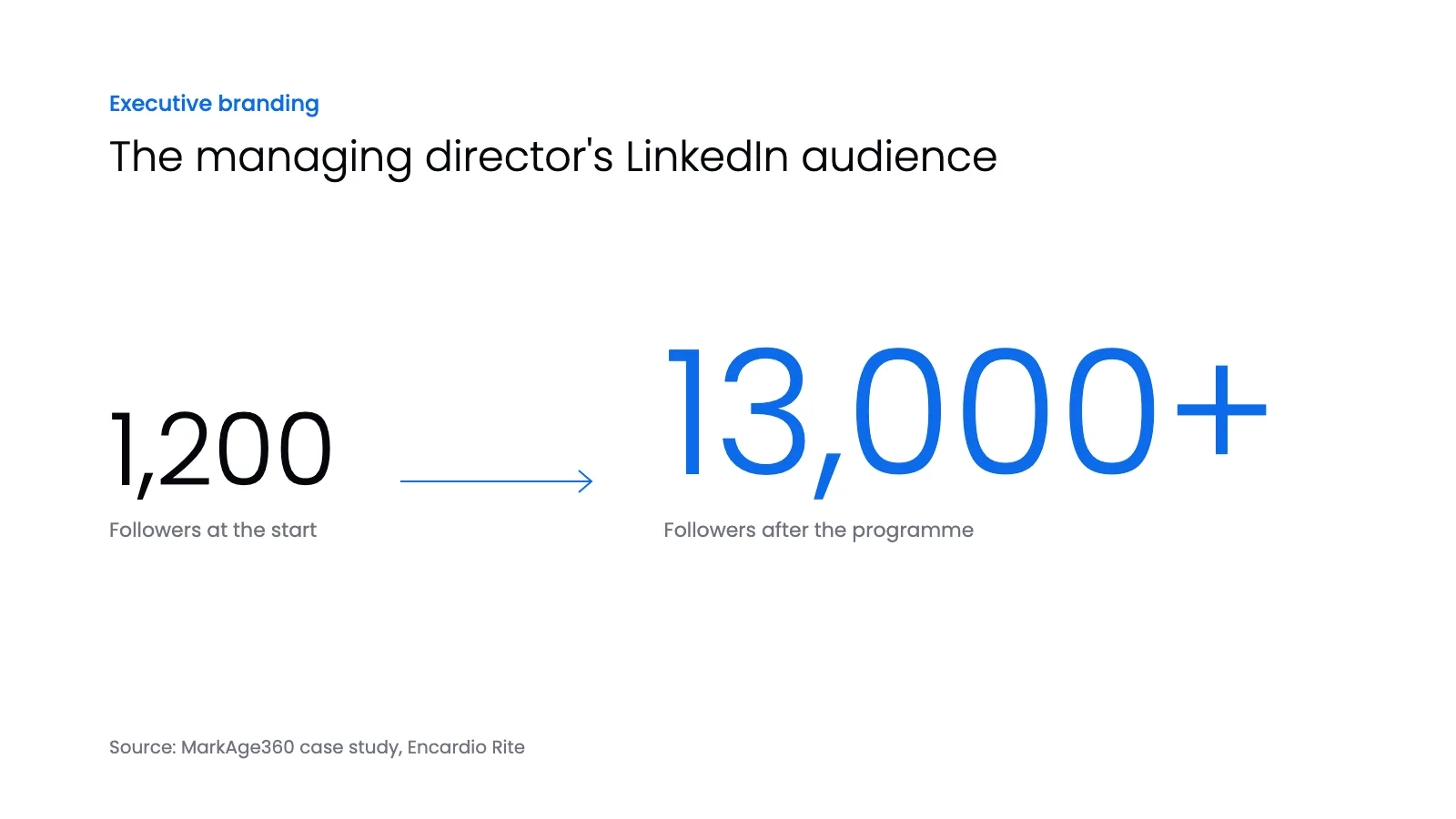
We built the Encardio Rite managing director's presence on LinkedIn alongside the search programme. The managing director's LinkedIn audience grew from around 1,200 to more than 13,000, as published in our case study. That is a separate result from the search figures. A LinkedIn following does not raise a ranking by itself. What it does is put a credible person in front of the same engineers who later search.
LinkedIn is where consultants and EPC engineers in your export markets already spend professional time. A managing director who explains a monitoring problem there is showing the expertise directly. The reader meets the expertise first and the company second.
On the website, the same principle applies in smaller ways:
- Put the name and role of the approving engineer on every technical article.
- Give each named expert a profile page listing qualifications and project experience.
- Keep the name consistent between the site and LinkedIn.
What technical SEO does an engineering website need?
An engineering website needs the technical basics of SEO in place before any content can rank: pages that can be crawled and indexed, a clear structure, and a site that works on a phone.
- Indexing. Check in Google Search Console that product, application and project pages are indexed, and find out why any are not.
- One address per page. Use canonical tags so that filtered or duplicate product listings do not compete with the main page.
- Structure. Use breadcrumbs and internal links that follow the product, application and project map.
- Speed and mobile use. Large drawings, photographs and embedded PDFs slow a page. Compress them and test on a phone.
- Structured data. Mark up articles, breadcrumbs and products where it is accurate. It helps a search engine read the page and does not guarantee a higher position.
- Countries and languages. Use hreflang only where you publish distinct versions for different countries or languages.
How do you turn search traffic into qualified engineering enquiries?
Search traffic turns into qualified enquiries when every technical page offers a next step that suits an engineer, and when you can trace an enquiry back to the page that produced it. A generic contact form at the end of a long article does neither.
- Put a relevant action on each page: request a quotation, ask an applications engineer, or download the datasheet.
- Keep enquiry forms short, and ask for the application and the country, because those two answers tell sales how to respond.
- Record the source of every enquiry in your analytics and your CRM, so that an order months later can be traced to the search that started it.
- Report enquiries by country and by page type. A rise in visits with no rise in relevant enquiries is a warning.
Did the Encardio Rite rankings last after the work ended?
The rankings that carried the most traffic held. Our engagement with Encardio Rite ended in January 2023. In a July 2026 export of ranking data, more than three years later, 99 of the 100 highest-traffic ranking entries were still in Google's top ten, and 47 of them were in first position.
The more important figure is in the same export. Of those 100 entries, 96 were non-branded searches. The people arriving had typed a product, an application or a question, and not the company's name. They were finding a manufacturer they may not have known existed.
A single export is a snapshot, so it shows where those pages stood on that date. It says nothing about the months in between. Even so, that is the gap between this and a typical B2B SEO case study, which reports a peak and stops. A peak can come from one page or one lucky term. Ninety-nine of a hundred holding in the top ten describes pages that keep answering what engineers search for.
Pages built on the specification question, the application and the project reference do not go out of date quickly, because the engineering does not. They still need tending. A search programme that stops publishing will give ground over time to competitors that keep going.
Should engineering companies optimise for AI search?
Engineering companies should optimise for AI search, and the work overlaps almost entirely with good technical publishing. As of November 2026, the tools an engineer is likely to use include Google AI Overviews, ChatGPT, Perplexity, Gemini and Microsoft Copilot. Each one summarises what it finds and often points to its sources, so a passage has to make sense when lifted out of its page. Google's own guidance is that AI features need no special optimisation beyond sound SEO practice.
Four habits make engineering content quotable:
- Open every section with a complete answer that names its subject, so it reads correctly with nothing above it.
- Keep specifications in tables and procedures in numbered steps.
- Keep the content in web pages. Text locked in scanned PDFs is far harder for any system to use.
- State the same facts about your company, products and experts everywhere they appear.
The product, application and project map from Lesson 1 already produces most of this. We cover the remainder under AI search optimisation. For the tooling side, see our guide to what to automate in SEO and what must stay human.
How do you choose an SEO agency for an engineering company?
Choose an SEO agency for an engineering company by testing whether it can produce content your own engineers will sign off, and whether it can show rankings in export markets with a named tool and a date. General marketing credentials tell you little. The risk you are managing is copy that embarrasses you in front of a consultant.
| Ask the agency | A good answer |
|---|---|
| Who writes, and who checks the engineering? | A writer structures, your named engineer approves, and nothing is published without that approval |
| Can you show a ranking for a technical term in an export market? | A specific term, country, position, tool and date |
| How would you structure our site? | By product, application and project, or a reasoned alternative |
| What will you report? | Non-branded rankings and enquiries by country, not total visits |
| What happens to our datasheets and reports? | Key content moves onto web pages, with PDFs kept as downloads |
Ask to read something the agency wrote for a technical client, and hand it to your most sceptical engineer. Their reaction is the best single test in marketing for engineering firms.
Hold us to the same questions. The Encardio Rite figures in this guide are the kind of evidence you should ask any engineering marketing agency for, and Encardio Rite rated our work 5.0 on Clutch.
Where should an engineering exporter begin?
An engineering exporter should begin with an audit of what already exists, because the raw material is almost always there. Encardio Rite's authority was built on site over many projects. The search programme made it legible.
In summary, the seven lessons are these. Map the market by product, application and project. Put the specification on the product page. Build application pages. Give each landmark project its own page. Have engineers approve what writers structure. Track every country separately. Put a named expert behind the work.
Take the ten project references your export sales team quotes most often and search for each one as a stranger would, by structure type and monitoring problem. Count how many lead to a page on your own site. That number is the size of your gap.
Then read how we approach search and content for geotechnical and engineering firms, and compare it with the list you have just made.
Frequently asked questions
Does an engineering firm need a blog?
Not a blog for its own sake. It needs pages that answer the technical questions buyers search, such as how an instrument works or how a structure is monitored. Whether those sit in a blog, a knowledge section or the application pages matters less than two things: an engineer has approved them, and they link to the relevant products and projects.
Does SEO work for engineering firms when most work comes through referrals and tenders?
Yes. Referrals and tenders decide who wins, but search influences who is known when the specification is drafted. In a July 2026 export of Encardio Rite's ranking data, 96 of the 100 highest-traffic entries were non-branded searches, made by people looking for a product or an answer and not for the company's name.
How long does SEO take for an engineering company?
There is no honest fixed figure, because it depends on the state of the site, the competition for each term and how fast engineer-approved content can be published. Results tend to arrive in an order. Specific technical questions rank first, broad product terms later, and each export market moves on its own schedule.
Is AI search different work from Google SEO?
It is mostly the same work. AI answer tools summarise pages and cite them, so sections that open with a complete answer, specification tables and content held in web pages all help. A site built for practising engineers is already most of the way there.
Can we publish project pages without naming the client?
Yes. Describe the structure type, the region, the monitoring problem, the instruments used and the outcome, and leave the client's name out. Check the contract's confidentiality terms before publishing. A named reference is stronger, but an unnamed page with real engineering detail is still useful proof.
Should datasheets and technical reports be PDFs or web pages?
Both, with the web page as the primary version. Put the specifications and key content on a page that can be read on a phone, linked to related products and measured. Offer the PDF as a download for engineers who want to file it.
Who should approve technical content before it goes live?
A named practising engineer inside your company, usually a product or applications lead, should approve every technical statement. Marketing or the agency should own structure and readability. One approver per subject keeps the process moving and gives you a credible name to publish as reviewer.
What should we prepare before briefing an SEO agency?
Prepare a list of your product families, the applications each one serves, and the project references you are allowed to name. Arrange access to Google Search Console and your analytics. Name the engineer who will approve technical content, because that approval is what the whole programme depends on.
Found this useful? Add MarkAge360 as a preferred source and Google will show you more of our articles in Top Stories and AI answers.

Shekhar Malhotra
CEO & Founder, MarkAge360
Shekhar Malhotra is the CEO and Founder of MarkAge360, founded in 2020 after leading digital marketing work since 2016. Shekhar leads B2B marketing, growth hacking, strategy and AI work for education, ecommerce and geotechnical companies.
Writes aboutB2B marketingGrowth hackingStrategyAI in marketing